
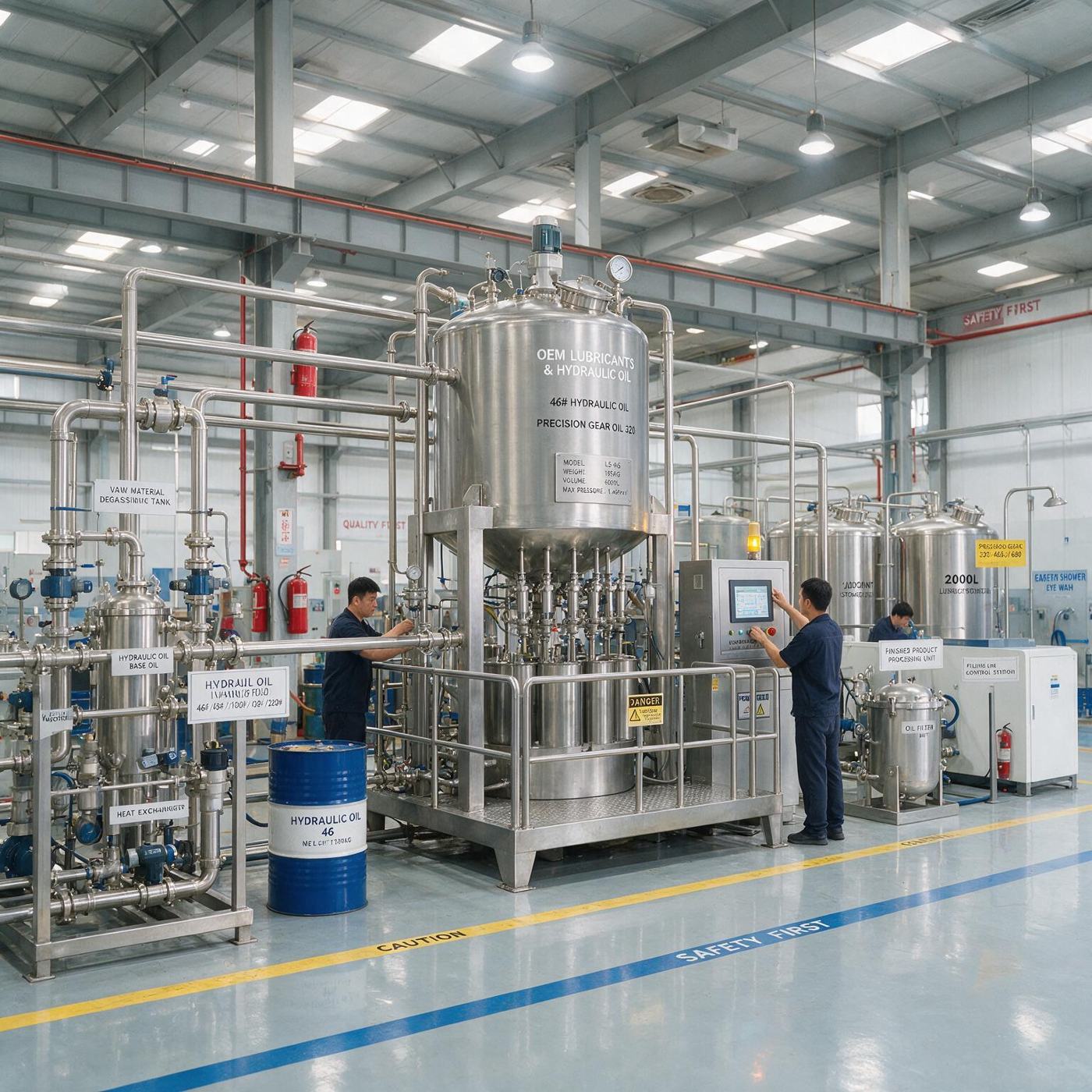
When entrepreneurs begin planning their own lubricant brand, one major question often comes up: should we build our own factory? Owning manufacturing capacity can create significant long-term advantages, but for a new lubricant brand still validating its market, factory ownership may not be the most important priority.
A more important question may be: how quickly can you get your product into the market? Business opportunities do not always wait for a company to finish constructing a facility, installing equipment, hiring production teams and developing manufacturing systems — which is one reason OEM lubricant manufacturing and private label lubricants can provide a practical route to market for businesses that want to launch faster while reducing initial capital requirements.
1. Building a Factory Takes Time Before It Generates Revenue
Building a lubricant manufacturing facility involves much more than renting a building and purchasing a filling machine. A company may need to invest in:
- Land or facilities
- Storage tanks
- Blending equipment
- Filling lines
- Packaging equipment
- Raw material storage
- Finished goods warehousing
- Quality control facilities
- Technical personnel
- Production staff
- Manufacturing systems
- Operational and regulatory requirements
All of these require time and capital before the first commercial bottle reaches a customer. During that period the market continues moving — competitors may enter, distributors may sign with another supplier, customer requirements may change. The opportunity identified at the start of the project may no longer look the same by the time the factory is ready.
2. What Does Speed to Market Mean?
Speed to market is the time required to take a business idea from concept to a product customers can actually buy: market opportunity → product selection → branding → manufacturing → delivery → sales. The faster this cycle becomes, the sooner a business can obtain real market feedback — and real customer behavior is usually far more valuable than assumptions made before launch.
3. Launching Earlier Helps Validate Real Demand
One of the biggest risks when developing a new lubricant brand is investing heavily before knowing what customers actually want. You may believe your market needs 5W-30; your customers may prefer 10W-40. You may expect 5L packaging to become your main seller; distributors may tell you 4L sells better. You may position the brand as premium; the market may actually be much more price-sensitive.
If a company spends years developing its own factory before selling the first product, these assumptions may remain untested for too long. Working with an OEM lubricant manufacturer can help a brand enter the market earlier and use actual sales data to refine its strategy.
4. A Factory Does Not Create a Market
There is an important distinction between manufacturing capability and market capability. Owning a factory does not automatically create customers, distributors, dealers, brand awareness, market demand, customer trust or sales.
A factory may have the capacity to produce millions of liters, but if the business does not yet have sufficient distribution, that manufacturing capacity can become a fixed cost rather than a competitive advantage. For a new lubricant brand, capital may create more value when invested first in market development, product strategy, branding, sales and distribution.
5. OEM Can Convert Fixed Investment Into a More Flexible Cost Structure
Owning a factory creates expenses regardless of production volume — equipment depreciation, fixed employees, maintenance, warehousing, utilities, production management and capital tied up in equipment and facilities.
With OEM lubricant manufacturing, a brand can use the existing production capacity of an established manufacturer. This reduces the need to invest heavily in manufacturing assets from day one and allows more capital to remain available for commercial activities — especially valuable for companies entering a new country or testing a new market.
6. Speed Allows You to Learn Faster
The first company to enter a market does not always win, but companies that learn quickly often gain an advantage. Once your products are being sold, you can begin answering important questions:
- Which products sell fastest?
- Which SKUs move slowly?
- What do customers say about the product?
- Is the packaging right?
- Is the pricing appropriate?
- What support do distributors need?
- Which products should be added next?
This information allows a business to improve its portfolio before committing additional capital — one of the strongest advantages of entering the market quickly through an OEM or private label lubricant model.
7. Owning a Factory Too Early Can Distract the Business
A new lubricant brand already has many challenges to manage — products, branding, marketing, website, pricing strategy, distribution channels, sales teams, customer service, inventory and cash flow.
If the same organization is also operating a manufacturing facility, management must additionally handle raw materials, formulations, production planning, equipment, factory personnel, maintenance, quality control, operational safety and production efficiency — dividing management attention during the period when the brand needs maximum focus on market development.
8. OEM Lets Businesses Focus on Their Real Competitive Advantage
Not every company needs manufacturing to be its core competency. Some companies are strongest in distribution, customer relationships, local market knowledge, marketing, international trade, branding, service or B2B sales.
If these are your competitive advantages, it may make sense to invest in strengthening them while using an OEM lubricant manufacturer for production — the manufacturer focuses on manufacturing, the brand owner focuses on building the market.
9. Speed Matters Even More in Export Markets
For importers and distributors developing private label lubricants, market opportunities are often time-sensitive: a distributor may be replacing an existing supplier, a country may be experiencing rapid growth in a particular vehicle segment, a major customer may be looking for a new source, a competitor may have exited the market, or a workshop chain may be looking for its own private label product.
In situations like these, the ability to launch within the right commercial window can be more valuable than owning a production facility — entering the market after the opportunity has passed may result in a completely different business outcome.
10. OEM Does Not Mean Losing Control of Your Brand
Some businesses assume that outsourcing manufacturing means giving up control. That does not have to be the case — a brand owner can still control critical commercial decisions such as brand positioning, product portfolio, viscosity grades, technical requirements, packaging design, pack sizes, pricing, marketing, distribution and customer experience.
The OEM manufacturer handles manufacturing according to the agreed scope; the brand owner continues to control the most valuable commercial assets — the brand and the customer relationship.
11. When Does Factory Ownership Start to Make Sense?
None of this means factory ownership is always a bad idea. Owning a lubricant manufacturing facility may become strategically attractive when the business has sufficient production volume, predictable demand, a proven product portfolio, established distribution, strong cash flow, operational capability and a clear strategic reason for deeper manufacturing control.
At that point, factory ownership may improve cost efficiency, provide greater control and create long-term manufacturing capabilities. The important issue is timing: validate the market first, scale the business second, invest in manufacturing when the economics justify it. A factory should ideally support proven demand rather than become a large investment that the business then needs to find demand for.
OEM Manufacturing or Your Own Factory: Where Should You Start?
Instead of asking "should we own a factory?", a more useful question may be "what is the fastest and most capital-efficient way to reach customers and validate this market?" If the market is still being tested, an OEM strategy can help a company reduce upfront investment, shorten launch time, test different markets, reduce fixed-asset risk, allocate more capital to sales and marketing, and collect market data before scaling.
This is why many businesses begin by working with an OEM lubricant manufacturer before considering their own production facility.
Looking for an OEM Lubricant Manufacturer to Launch Faster?
If you are searching for an OEM lubricant manufacturer in Vietnam, private label lubricant manufacturer, engine oil manufacturer or lubricant supplier, the first conversation should begin with your market rather than the factory. Useful information includes target country, product categories, viscosity grades, packaging sizes, expected quantities, target customer segment and distribution channels.
From there, an OEM program can be developed around the commercial needs of your market. Whether you are building a brand for engine oil, motorcycle oil, diesel engine oil, hydraulic oil, gear oil or industrial lubricants, the goal is not simply to manufacture products — it is to reach the right customers while the opportunity still exists.
You do not necessarily need to own a lubricant factory to own a successful lubricant brand. In the early stages, your greater competitive advantage may simply be getting the right product into the right market faster.