
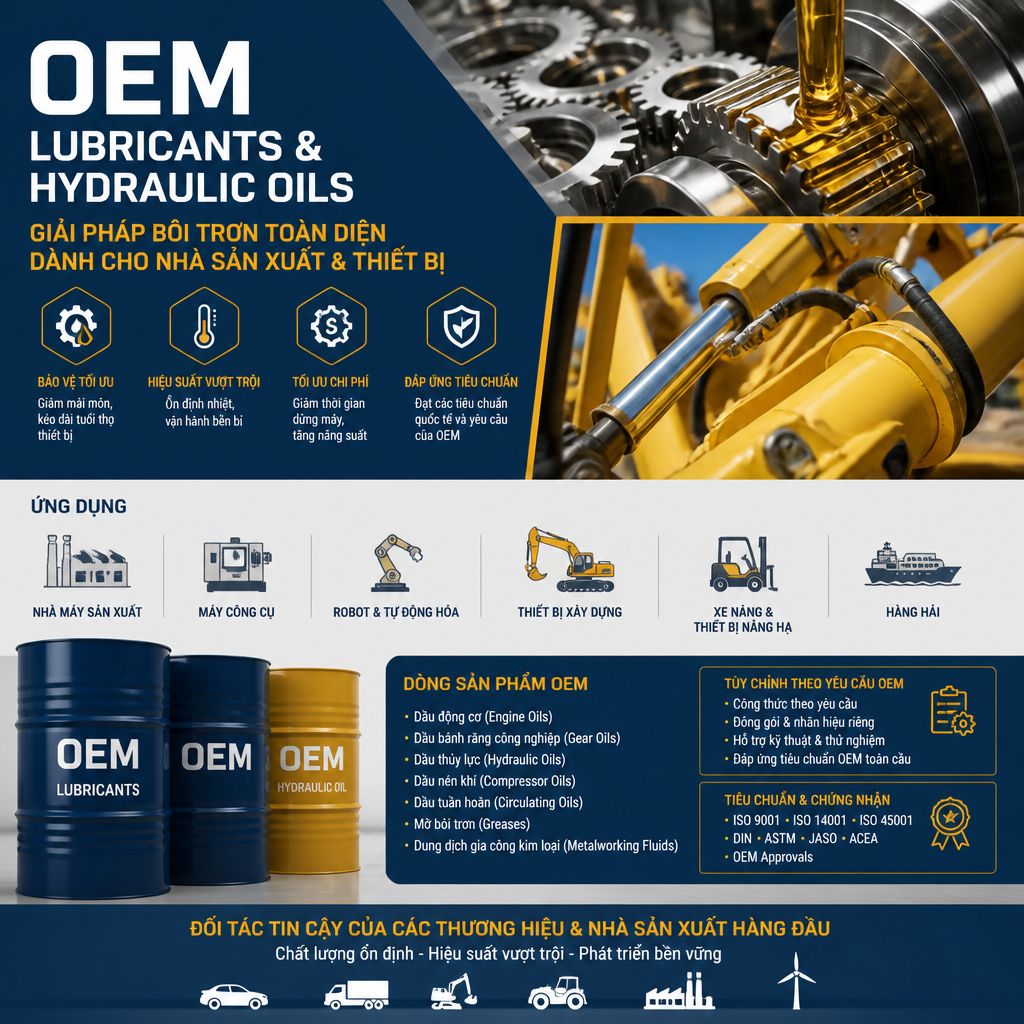
Launching your own lubricant brand does not necessarily mean building a factory, developing every formulation from zero, or investing millions of dollars in manufacturing infrastructure.
For many distributors, automotive businesses, wholesalers, entrepreneurs and existing lubricant companies, there is another option: private label lubricants.
Under a private-label model, an established manufacturer produces lubricants that are sold under your own brand. You focus on the market, the brand, customers and distribution — while the manufacturing partner focuses on production. It can be one of the fastest ways to enter the lubricant market, but it is not automatically the right model for everyone.
What Are Private Label Lubricants?
Private-label lubricants are products manufactured by a third-party producer and sold under another company's brand. A qualified lubricant manufacturer may already produce:
- Passenger car motor oil
- Motorcycle oil
- Heavy-duty diesel engine oil
- Gear oil
- Transmission fluid
- Hydraulic oil
- Grease
- Industrial lubricants
You select suitable products, specifications and packaging. The manufacturer then produces and packages the products under your brand. Your customer sees your brand, not the manufacturer's — allowing you to become a lubricant brand owner without immediately becoming a lubricant manufacturer.
Private Label, OEM and ODM — Are They the Same?
The terms are often used interchangeably, but there can be important differences.
Private Label
You normally select from products or formulations the manufacturer already offers and customize brand, label, packaging and product name. This is usually the fastest route.
OEM
The manufacturer produces according to your specified requirements — often with more customization in specification, performance level, packaging and technical requirements.
ODM
The manufacturer may support a greater part of product development, including formulation or product design.
In practice, the exact terminology can vary between manufacturers. What matters most is understanding how much of the product can be customized, and who controls the specification.
Why Is Private Label Attractive?
The biggest advantage is simple: you can enter the market without building manufacturing infrastructure. You do not need to invest immediately in blending tanks, filling lines, laboratories, warehouses, production employees, maintenance systems or environmental infrastructure. Instead, your capital can be allocated to inventory, sales, marketing, distribution, dealer development and working capital.
Who Is Private Label Lubricants Best Suited For?
1. Lubricant Distributors
If you already distribute other brands, you understand customers, pricing, fast-moving products, dealer behavior and local competition. Launching your own brand can give you more control over pricing, margin and market positioning — instead of only earning distribution margin, you begin building brand equity of your own.
2. Automotive Parts Distributors
Companies already selling filters, batteries, spare parts, tires or workshop equipment may already have access to the same dealers and workshops that purchase lubricants — private label lets them add a complementary product category to an existing sales network.
3. Workshop and Service Networks
A large workshop chain may use significant lubricant volumes. Instead of only purchasing established brands, it may develop a private-label lubricant for its own service network, gaining better control over purchasing, brand differentiation, higher margin and customer retention.
4. Fleet Operators
Large fleets may consume substantial quantities of engine oil, gear oil and other fluids. A private-label or dedicated supply arrangement can help standardize products and improve purchasing efficiency — though technical requirements and quality control become particularly important because equipment reliability directly affects operating costs.
5. Entrepreneurs With Strong Distribution
You do not necessarily need previous lubricant manufacturing experience, but having access to customers matters. If you already have dealer relationships, an automotive community, e-commerce reach, a regional distribution network or B2B customers, private label can help convert that market access into a proprietary product business.
When Private Label Is Probably NOT the Right Starting Point
You Do Not Know Who Will Buy the Product
If there is no clear buyer yet, the biggest risk is not manufacturing — it is inventory.
You Are Only Competing on the Lowest Price
A strategy built purely on price is difficult to defend, since another brand can always cut price further. A stronger strategy combines product, positioning, distribution, service and price.
You Want a Completely Unique Technology From Day One
Standard private-label formulations may not provide enough differentiation if your business requires proprietary technology — a customized OEM/ODM development model may be more suitable.
You Cannot Support the Initial MOQ
Manufacturers usually have minimum production requirements on product, viscosity grade, bottle size, label and carton. If your sales volume is too small, initial inventory can become a major burden.
You Have Not Calculated Working Capital
You may need to pay the factory before your customers pay you — that cash-flow gap must be planned.
The Biggest Question: Do You Already Have a Market?
Private label works best when production follows market demand. Before contacting manufacturers, ask: who will buy my lubricant, how many units can I realistically sell, which products move fastest, what price does my market accept, which packaging sizes are popular, and which specifications do customers require? If you already know these answers, private label becomes much easier to structure. If not, market research should come before manufacturing.
Private Label Can Improve Your Margin — But Only If the Numbers Work
One reason businesses launch their own lubricant brand is to capture more value in the supply chain — moving from Manufacturer → Brand Owner → Distributor → You, closer to OEM Manufacturer → Your Brand → Customer/Dealer. That can improve gross margin, but only if you understand the full cost: factory price, packaging, freight, import duty, customs, testing, warehousing, sales costs and marketing all add up to the total landed and commercial cost. Do not compare your private-label factory price directly with the wholesale price of an established brand without including these costs.
How Much Control Do You Want?
Level 1 — Basic Private Label
Existing formulation, existing bottle, your label. Usually the fastest and simplest model.
Level 2 — Customized Private Label
Existing formulation but customized packaging, label, product range and documentation.
Level 3 — OEM Development
Customized performance requirements, packaging and possibly formulation.
Level 4 — Fully Customized Product
Significant product development, testing and technical differentiation.
The more customization you request, the more you should expect higher development cost, higher MOQ, longer lead time and more technical work — the right level of customization should match the maturity of the business.
New Brands Often Over-Customize Too Early
A new brand owner may want a custom bottle mold, custom cap, unique formulation, ten viscosity grades, multiple carton designs, many certifications — everything from day one. This can dramatically increase development cost, MOQ, inventory, lead time and complexity. A leaner first launch may use a proven formula, existing packaging, custom branding and a focused product range, then use sales data to determine where further customization creates real value.
Is Private Label Lower Quality Than Major Brands?
Not necessarily. Quality depends on formulation, base oils, additives, manufacturing controls, testing, batch consistency and quality assurance. A private-label product can be manufactured to high standards — but it can also be poor quality if it is sourced only on price. Do not ask only for the lowest quote; also ask which formulation, which specifications, which raw materials, what testing is performed, how batches are controlled, whether documentation can be provided, and what quality systems are in place. Your brand name will be on the bottle, so the supplier's quality becomes your reputation.
Choosing the Right Private Label Manufacturer
A good manufacturing partner should be evaluated across several areas:
Technical Capability
Can the manufacturer produce the specifications you require?
Quality Control
How are raw materials and finished products tested?
MOQ
Does the production minimum match your market size?
Packaging Capability
Can they support the sizes and presentation you need?
Lead Time
Can they supply reliably?
Export Experience
Can they prepare the required commercial and shipping documents?
Communication
Can the team respond professionally and consistently?
Growth Capacity
Can the manufacturer support larger orders later?
Price matters, but it is only one part of supplier selection.
What Products Should You Launch First?
A new lubricant brand rarely needs a huge catalogue. Start by identifying high-demand products, strategic products that define your positioning, profitable products that create sustainable margin, and easy-to-replenish products that can be supplied reliably. The initial portfolio should be based on demand, not ego — a smaller product range with strong sales is usually more valuable than a large catalogue with slow inventory.
What About Packaging?
Private label often gives you several packaging choices, for example:
- 1 liter
- 4 liters
- 5 liters
- 20 liters
- 200-liter drums
- IBC
The correct choice depends on the customer: retail customers may prefer smaller bottles, workshops may prefer 20-liter pails, industrial users may prefer drums or IBCs. Packaging decisions should be linked to distribution channel, customer behavior and logistics cost.
Your Brand Still Needs a Reason to Exist
Private label makes manufacturing easier — it does not create demand automatically. You still need to answer: why should customers buy your brand? Possible answers include better value, local market specialization, strong dealer support, reliable availability, technical positioning, premium performance, or fleet/motorcycle/industrial specialization. Your logo is not the strategy — your value proposition is.
Private Label Can Be a Stage, Not the Final Destination
You do not need to choose one manufacturing model forever. A brand may evolve from private label using proven formulations, to customized packaging and expanded product range, to OEM-developed formulations, to exclusive/proprietary products, and eventually to hybrid or owned manufacturing if volume justifies it. This allows investment to increase as market evidence becomes stronger.
A Simple Private Label Readiness Test
Private label may be a good business model for you if you can answer yes to most of these questions:
- Do you know which market you want to serve?
- Do you understand your target customer?
- Do you have a route to market?
- Do you know which products customers need?
- Can you support the manufacturer's MOQ?
- Can you finance the inventory cycle?
- Do you have a clear price position?
- Are you willing to build the brand over time?
- Can you manage quality and supplier performance?
- Do you have a plan for repeat orders?
If most answers are yes, private label may be worth serious consideration. If most answers are no, solve those questions before placing your first production order.
Private Label Is Not Just a Manufacturing Model
At its best, private label is a way to convert market access into brand ownership, and eventually long-term enterprise value. You are no longer simply reselling someone else's brand — you are building your customer base, your product portfolio, your pricing strategy, your supplier network and your market reputation.
Want to Know Whether Private Label Lubricants Are Right for Your Business?
You may already have an automotive distribution business, lubricant customers, workshops or dealers, a fleet, e-commerce customers, a target country, or simply an idea for your own brand — but may still be unsure about MOQ, product selection, manufacturer, formulation, packaging, quality, cost, logistics and import requirements.
DA Global Sourcing supports businesses from the initial concept through OEM/private-label sourcing and supply-chain execution. If you are considering your own lubricant brand, send us your target country, customer segment, products you want to launch, estimated quantities, packaging requirements, target price if available, and current stage of the project.
You bring the market opportunity. DA Global Sourcing helps build the product and supply chain behind it.