
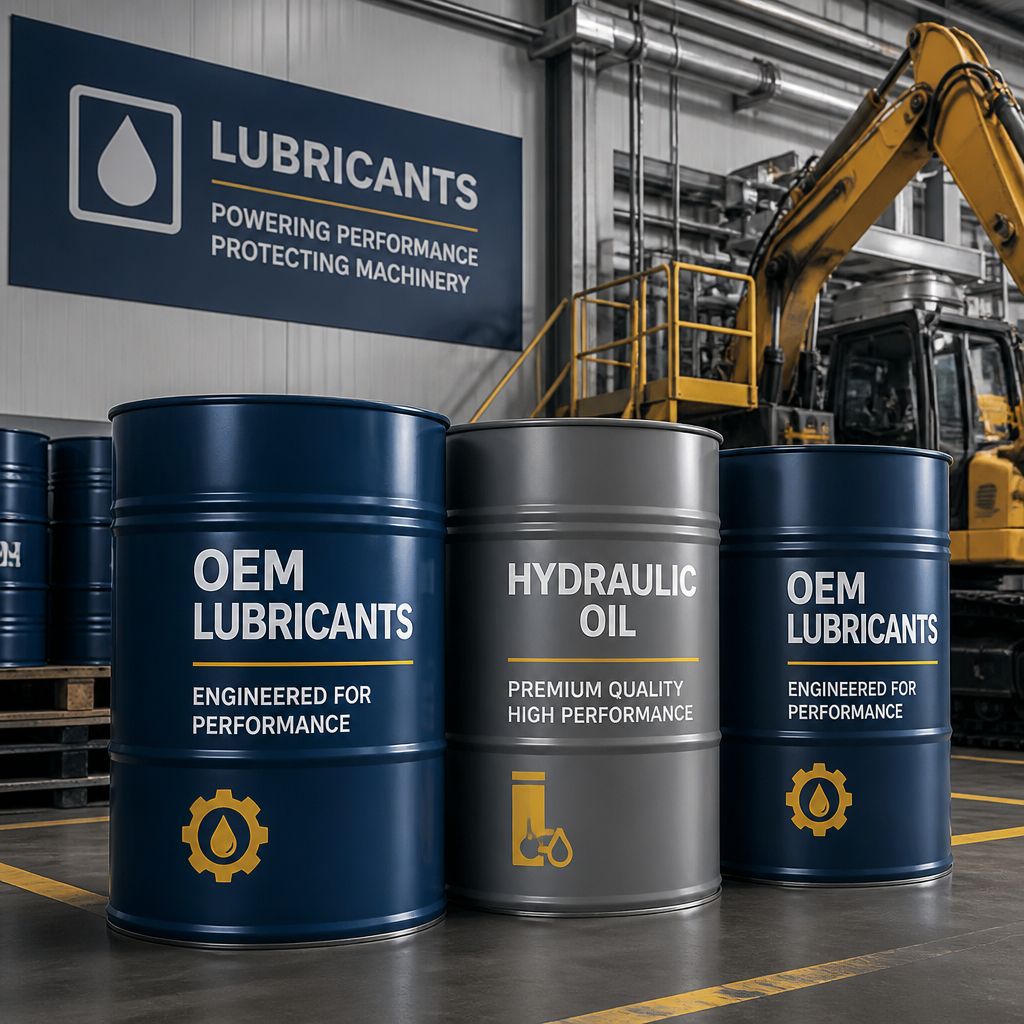
If you are planning to launch your own lubricant brand, one of the biggest decisions you may face is:
Should I build my own lubricant factory, or should I work with an existing OEM manufacturer?
Many new brand owners naturally assume that owning a factory gives them more control, better pricing and greater credibility.
Sometimes it does.
But building a factory also requires substantial capital, technical knowledge, regulatory compliance, production management, laboratory capability, raw-material procurement and enough sales volume to keep the facility operating efficiently.
For many new lubricant brands, there is another path:
Build the Brand First. Use the Right Manufacturing Partners Behind It.
With the right OEM and supply-chain structure, you can develop and launch your own lubricant brand without owning a factory.
The real question is therefore not: “Should I own a factory?” It is: “What manufacturing model gives my brand the best chance of succeeding?”
Owning a Lubricant Brand Does Not Mean You Must Own a Factory
A lubricant brand and a lubricant factory perform very different functions.
A successful brand needs to understand:
- Its target market
- Its customers
- Product positioning
- Pricing
- Distribution
- Dealer development
- Marketing
- Customer service
A factory needs to manage:
- Base oils
- Additives
- Formulation
- Blending
- Filling
- Packaging
- Laboratory testing
- Quality control
- Production planning
- Equipment
- Environmental and regulatory requirements
Trying to build both businesses simultaneously can consume a significant amount of capital and management attention. That is why many businesses begin with OEM, Private Label or Contract Manufacturing — they own the brand and the customer relationship while qualified manufacturing partners produce the products.
What Does Building Your Own Lubricant Factory Really Require?
A lubricant blending plant is much more than several tanks and a filling machine. Depending on the market and production scale, you may need to invest in:
Land and Infrastructure
- Factory land
- Production buildings
- Warehouses
- Loading areas
- Utilities
- Fire-protection systems
- Environmental systems
Production Equipment
- Base-oil tanks
- Additive tanks
- Blending vessels
- Pumps and pipelines
- Heating systems
- Filtration equipment
- Filling lines
- Labeling equipment
- Packaging equipment
Laboratory and Quality Control
A professional operation may also require laboratory equipment, testing procedures, qualified technicians and batch-control systems.
People
You may need production managers, formulation specialists, QC personnel, laboratory technicians, maintenance personnel, procurement, warehouse staff and production workers.
Working Capital
Even after the factory is built, you still need money for base oil, additives, bottles, caps, labels, cartons and inventory.
Do you want to invest your first major capital into manufacturing infrastructure, or into building the market for your brand?
The Cost That Many New Brand Owners Forget: Unused Capacity
Suppose you build a plant capable of producing 10 million liters per year, but during the first year your distribution network sells only 1 million liters. Your equipment may be operating at only a fraction of its capacity — yet you still carry salaries, utilities, maintenance, factory management, compliance, laboratory costs, depreciation and warehouse costs.
This can make the real manufacturing cost per liter significantly higher than expected. A factory becomes financially attractive when there is enough predictable production volume to utilize it efficiently. For this reason: sales volume should justify the factory — not build the factory and hope the sales will come.
What Changes When You Work With an OEM Manufacturer?
An established OEM manufacturer may already have blending systems, filling lines, laboratories, formulation capability, raw-material suppliers, packaging suppliers, quality-control systems, production teams and export experience.
Instead of building those capabilities yourself, you purchase manufacturing capacity when you need it. Your capital can then remain focused on product development, inventory, branding, marketing, sales, dealer development, distribution and working capital — a powerful strategic advantage for a new lubricant business.
OEM Can Help You Enter the Market Faster
Building Your Own Factory
Business idea → Factory planning → Land → Permits → Equipment → Installation → Recruitment → Raw-material sourcing → Trial production → Quality system → Commercial production → Market launch.
Working With an Existing OEM Manufacturer
Business idea → Target market → Product strategy → OEM manufacturer selection → Formulation → Sample → Packaging → Testing → Production → Shipping → Market launch.
The second route can significantly reduce the time required to turn an idea into a commercial product. And for a new brand, speed to market matters — every month spent building infrastructure is a month in which competitors can continue developing customers and distribution.
But Choosing an OEM Factory Is Not as Simple as Finding the Cheapest Quotation
This is where many new lubricant brands make mistakes. Searching online may give you dozens of manufacturers, but a low quotation does not tell you whether the factory is reliable, whether the formulation matches your market, whether raw materials are consistent, whether production quality is controlled, whether packaging will meet expectations, whether the factory can deliver on time, whether export documents will be correct, or whether the manufacturer can support your growth.
The wrong OEM partner can damage your brand before it has had a chance to grow. A more professional supplier-selection process should include: Product Requirement → Manufacturer Search → Factory Verification → Technical Evaluation → RFQ → Commercial Comparison → Sample Development → Testing → Quality Approval → Production.
Can You Control Quality Without Owning the Factory?
Yes — but only if quality is managed systematically. The key is not simply “which factory produces the product?” The key is “what standards must the factory follow?”
Before mass production, the project should define:
Product Specification
What exactly is being produced?
Approved Formulation
Which performance level and raw-material system will be used?
Approved Sample
What is the reference standard?
Packaging Standard
Bottle, cap, label, carton and printing requirements.
Quality-Control Criteria
What must be tested and inspected?
During production this may require batch control, production monitoring, laboratory testing and packaging inspection. Before shipment: final inspection, documentation review, product verification and shipment approval.
Quality comes from specification + control + verification — not simply factory ownership.
OEM Also Has Risks — So Supplier Management Matters
Outsourcing production does not eliminate risk. Possible problems include quality inconsistency, production delays, raw-material substitutions, packaging defects, poor communication, documentation errors, capacity shortages, formula confidentiality and dependence on one supplier.
This is why a brand should not simply have a factory — it should develop a supply-chain strategy that may eventually include a primary manufacturer, backup manufacturer, approved packaging suppliers, quality-control procedures, logistics partners and supplier performance data. This creates resilience as the business grows.
When Does Building Your Own Factory Make Sense?
There is absolutely a point where factory ownership can become the right strategy. It becomes more attractive when:
1. Your Sales Volume Is Large and Predictable
You can utilize production capacity efficiently.
2. You Have a Stable Distribution Network
The factory will be supported by real market demand.
3. Manufacturing Technology Creates Competitive Advantage
Your formulation or process provides meaningful differentiation.
4. You Need Greater Control
For technical, confidentiality or scheduling reasons.
5. You Have Sufficient Capital
The factory will not consume the capital needed for inventory, sales and expansion.
6. You Have Manufacturing Management Capability
Operating a factory requires specialist knowledge and management systems.
At that stage, owning production capacity may improve margins, control and long-term strategic value.
When Is OEM Usually the Better Starting Point?
OEM may be more appropriate when you are launching your first lubricant brand, you are still validating the market, sales volume is uncertain, you want to minimize fixed investment, you want to launch faster, you want to focus capital on sales and distribution, you need several different product technologies, you want to test multiple markets, or you want the flexibility to change suppliers.
For many entrepreneurs and distributors, OEM is not simply a cheaper way to manufacture — it is a way to test and build the business before committing large amounts of capital.
You Can Start With OEM and Build a Factory Later
The decision does not have to be permanent. A brand can develop through several stages.
Stage 1 — Market Validation
Use OEM/private label manufacturing to build customers, distribution, brand awareness and sales data.
Stage 2 — Strategic OEM Network
Develop multiple products and qualified manufacturing partners.
Stage 3 — Hybrid Manufacturing
Build your own production capacity for high-volume products while continuing to outsource specialized products.
Stage 4 — Integrated Manufacturing
Own manufacturing becomes part of a larger global supply-chain strategy.
In this model, the factory is built because the market has justified it — very different from building a factory first and hoping the market will follow.
A Practical Decision Framework
Before deciding whether to build or outsource production, answer these questions:
- Which country or region will you sell in?
- Who will buy your products?
- Which lubricant products will you launch first?
- How many liters can you realistically sell in the first 12 months?
- What volume do you expect after three years?
- What product specifications are required?
- What packaging does the market require?
- How much capital do you have available?
- How much working capital will the business require?
- Can qualified OEM manufacturers already produce what you need?
- What risks would outsourcing create?
- At what annual volume would your own factory become financially attractive?
If you cannot confidently answer these questions yet, building a factory may be premature.
You Don't Need a Factory to Start Building Your Lubricant Brand
You need a market, a product strategy, the right formulation, a reliable OEM manufacturer, professional packaging, quality control, a reliable supply chain, distribution, and customers. Factory ownership can come later if the economics justify it — the first objective should be to prove that customers want your products.
Talk to DA Global Sourcing About Your Lubricant Project
If you are considering launching your own lubricant brand, tell us your target country, target market, products you want to develop, estimated quantity, packaging requirements, and target price if available.
DA Global Sourcing can help you evaluate the project and identify an appropriate OEM and supply-chain approach.
You build the market. We help build the supply chain behind your brand.