
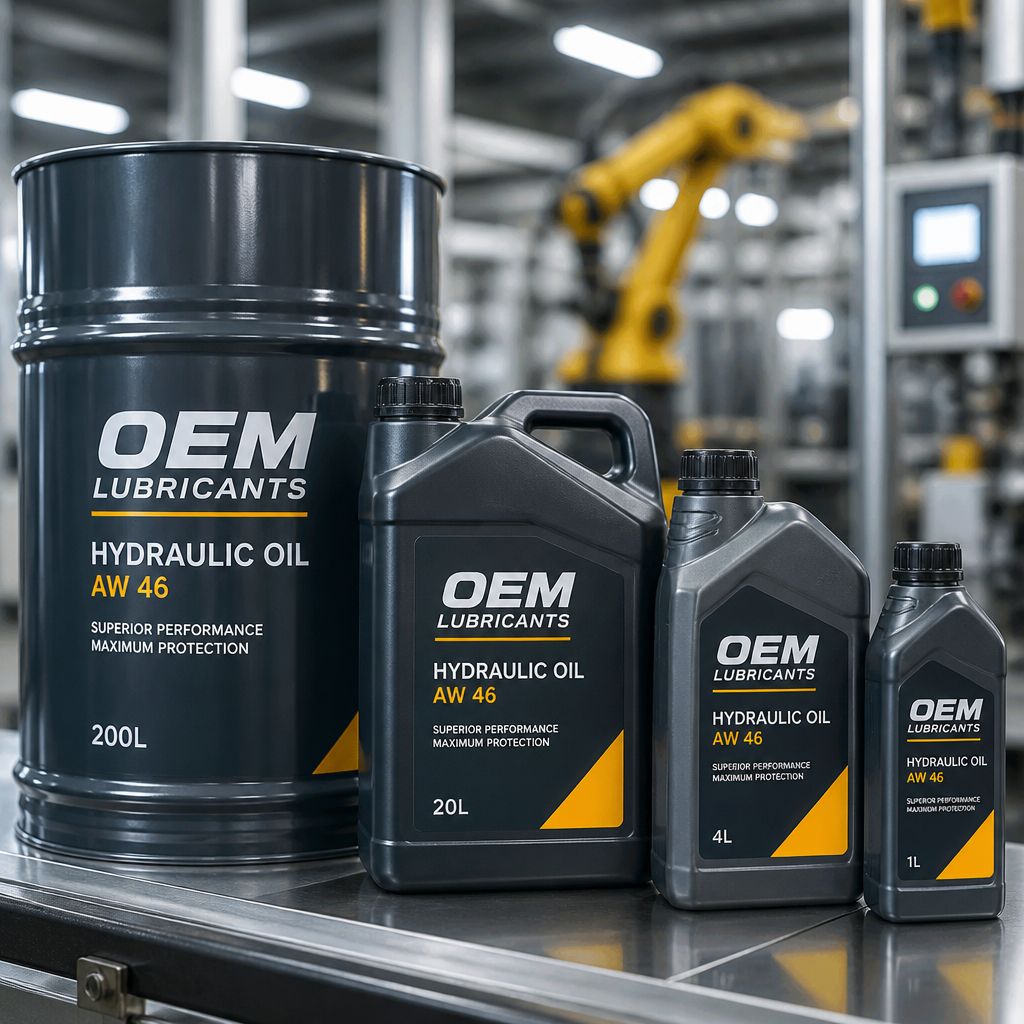
One of the easiest mistakes to make when planning to start your own lubricant brand is beginning with the product too early. Should you launch 5W-30 or 5W-40? Which performance level should you target? 1L, 4L or 5L packaging? Which OEM lubricant manufacturer offers the best price? What is the minimum order quantity? These are important questions — but they should come after a more fundamental one: what is your brand strategy?
A lubricant brand is not created simply by putting a logo on a bottle. It begins with understanding the market, identifying an opportunity, defining the customer, establishing a clear position, and only then developing the products and supply chain required to deliver that strategy. This is also how DA Global Sourcing approaches OEM and private label lubricant sourcing projects: start with the business case, then work backward toward the product and sourcing requirements.
Don't Start With "What Can the Factory Produce?"
Imagine you decide to launch a lubricant brand. You contact a manufacturer and receive a catalogue with dozens of products — 0W-20, 5W-30, 5W-40, 10W-40, 15W-40, transmission fluids, hydraulic oils, gear oils, industrial lubricants. You choose several, request prices, design a logo and prepare an order. Only then do you ask: who is going to buy these products?
That sequence (Factory → Product → Packaging → Brand → Customer) creates unnecessary risk. A more strategic approach is: Market Opportunity → Target Customer → Brand Positioning → Product Strategy → Sourcing → Distribution. You should not build your business around what a factory wants to sell — you should build your supply chain around what your business needs.
1. Define the Market Before the Product
Before deciding which lubricants to launch, decide where you are going to sell them — Southeast Asia, the Middle East, Africa, Europe, or a specific national or regional market? Different markets can have very different vehicle populations, average vehicle ages, operating conditions, popular viscosity grades, price structures, buying behavior, distribution channels, competitive landscapes, technical requirements and regulatory/import requirements.
There is no single "perfect" lubricant portfolio for every country — your product portfolio should be built around market reality. A serious private label project should begin with a market brief, not a manufacturer's price list.
2. Define Exactly Who Will Buy Your Lubricants
"Car owners" is not a sufficiently precise target market. Are you building the brand for independent workshops, workshop chains, lubricant distributors, automotive parts retailers, fleet operators, transport companies, individual vehicle owners, industrial customers, or importers in a specific country?
Consider three hypothetical brands: Brand A targets workshops servicing modern passenger vehicles, Brand B focuses on commercial trucks and fleets, Brand C serves motorcycle users in a highly price-sensitive market. All three are lubricant brands, but almost every element of their strategy — product, specification, packaging, pricing, distribution, marketing — could be different.
3. Identify a Reason for the Brand to Exist
A new lubricant brand should not exist simply because it is possible to manufacture one — it needs a commercial reason to exist. Study the market and ask:
- What are customers dissatisfied with?
- What are distributors struggling to source?
- Is there a gap between economy and premium brands?
- Are dealers looking for better commercial economics?
- Is a particular vehicle segment underserved?
- Do competitors have availability problems?
- Is there a niche large enough to build around?
This is where market intelligence begins shaping product strategy. The opportunity does not always need to be a revolutionary formulation — sometimes it lies in a better combination of product, price, availability, distribution and brand experience.
4. Define Your Position Before Defining the Specification
Where should your brand sit in the market — economy, mid-market or premium? But positioning is about much more than price. Ask: what should customers remember your brand for? Perhaps it is strong value within a defined segment, specialization in a vehicle category, a focused and easy-to-understand range, modern brand presentation, strong distributor support, reliable supply, or flexible B2B service.
A new brand does not automatically need to be "premium" — it needs to be relevant. A clear market position is far more useful than a generic statement that almost every lubricant company could make. Your positioning should explain why your particular customer should care.
5. Build a Value Proposition for Distributors, Not Only End Users
If your route to market depends on distributors, dealers and workshops, you have two audiences to convince: the end user (why should they trust and choose the product?) and the channel partner (why should they invest working capital, shelf space and sales effort in your brand?).
A dealer may already carry five or ten lubricant brands, so you need a compelling distributor/dealer value proposition — commercial margin, territory strategy, product availability, focused portfolio, marketing materials, sales support, training, logistics, customer service, long-term growth potential. In the lubricant business, you are not competing only for customer demand — you are also competing for distribution attention.
6. Now Build the Product Portfolio
Once you understand the market, customer, market gap, positioning and distribution, you can make a much better decision about which SKUs you actually need. A new brand does not need to prove its credibility with a 50-product catalogue — if five SKUs can address most of the initial commercial opportunity, five may be a better starting point than twenty.
Every additional SKU creates additional MOQ commitments, packaging inventory, label inventory, cartons, working capital requirements, warehouse requirements, forecasting complexity and slow-moving-stock risk. A useful principle for new lubricant brands: expand the range when actual sales data and customer demand justify doing so.
7. Let Brand Strategy Drive Product Specification
Once the market, customer and position are clear, you can develop a more meaningful technical brief — SAE viscosity grades, API performance categories, ACEA requirements, relevant OEM requirements, base oil strategy, additive technology, packaging formats, performance positioning.
There is also an important credibility principle: technical claims, approvals and certifications should only be used when properly supported. Long-term brands are built on credibility, not aggressive claims that cannot be substantiated.
8. Packaging Should Express the Strategy — Not Replace It
Your logo, bottle and label matter — but none of them is your brand strategy. They are the visual expression of that strategy. A brand targeting heavy-duty commercial fleets may need a very different visual language from one targeting passenger cars. An economy-positioned brand still needs to look credible and professional, but it does not need to imitate luxury positioning.
Within seconds of seeing the product, customers should understand what it is, who it's for, where it sits in the market, and why they should pay attention. Good packaging is not simply attractive — good packaging communicates positioning.
9. Only Then Find the Right OEM or Private Label Lubricant Manufacturer
Once the commercial brief is clear, sourcing becomes much more targeted. Instead of a vague request, you can approach potential manufacturing partners with a structured brief covering target market, target customer, brand positioning, product categories, initial SKU plan, packaging sizes, technical requirements, expected volume, target launch date and documentation requirements. At this point, you are no longer simply "asking for an oil price" — you are managing a structured sourcing project.
10. The Lowest Price Is Not Necessarily the Best Supply Solution
Price matters when evaluating an OEM lubricant manufacturer, but it should not be the only criterion. A more complete sourcing decision considers product capability, quality, MOQ, documentation, packaging, lead time, communication, export capability and commercial terms.
Supplier A may offer a lower unit price but require three times the MOQ; Supplier B may be slightly more expensive but offer an MOQ that better matches your market-testing strategy. Which is better depends on your business model — that is the difference between buying a product and building a supply chain.
11. Think Beyond the First Purchase Order
When developing your own lubricant brand, the objective should not simply be to complete the first production run. Consider whether the supply solution can scale with higher volumes, whether additional SKUs can be added later, whether packaging can evolve with the brand architecture, whether lead time supports the inventory strategy, whether documentation can meet the target market's requirements, and what happens if supply is disrupted.
A brand can be launched relatively quickly. A sustainable brand requires a supply chain capable of growing with the business.
The DA Global Sourcing Approach
DA Global Sourcing approaches OEM and private label lubricant projects from a broader perspective than simply locating a product. The starting question is: what are you trying to build? From there, the project is structured around market → customer → brand positioning → product requirements → supplier requirements → packaging → commercial & MOQ analysis → sourcing → supply-chain coordination. The objective is to turn a broad request into a structured sourcing brief so manufacturer sourcing and evaluation can become more focused.
Don't Start With a Factory. Start With a Strategy.
If you are considering starting your own lubricant brand, do not make your first question "which factory is the cheapest?" Start with: where do I want to sell, who is going to buy the product, how should the brand be positioned, why should distributors or dealers support it, and which SKUs are actually necessary for launch? Then ask which manufacturing and supply solution can best support that strategy. That is how you move from a product idea to a structured brand-building project.
Planning to Build Your Own Lubricant Brand?
You do not need to have every answer before beginning the conversation. To start a discussion with DA Global Sourcing, prepare five pieces of information: target country, target customer, product category, expected volume and estimated budget.
From there, DA Global Sourcing can help structure the sourcing requirements, identify the key questions that need to be resolved, and explore OEM/private label supply options aligned with the direction of the brand. Don't start with a bottle of oil — start with the brand you want to build.